
Young innovator wins Global Challenge with pharmaceutical waste-to-SAF concept
A student proposal to convert pharmaceutical waste into sustainable aviation fuel (SAF) has been named the winner of the Global Innovators Challenge at the Sustainable Skies World Summit.
Presented by 20-year-old Oscar Noone, the concept targets one of the most persistent barriers to SAF adoption: the availability of sustainable feedstocks at scale.
The competition, run by the UK’s largest aviation charity, the Air League, brings together young people aged 16 to 25 to develop solutions for aviation’s net-zero transition. This year’s challenge attracted a record number of submissions from six countries.
Why sustainable aviation fuel scaling still faces a feedstock shortage
Despite widespread industry commitment to decarbonisation, SAF production remains limited. Current estimates suggest that just 0.6% of global aviation fuel consumption is sustainable.
While multiple production pathways exist, including HEFA, Fischer-Tropsch and Alcohol-to-Jet (AtJ), they all rely heavily on biomass-based feedstocks. These are already under pressure from competing sectors such as agriculture, energy and road transport.
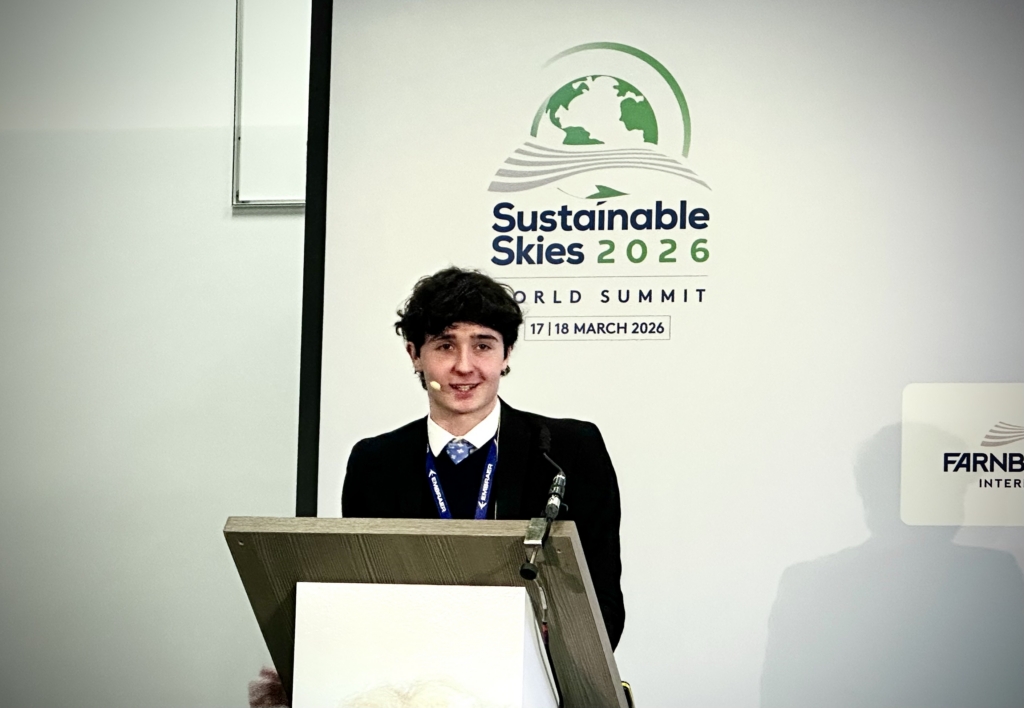
Noone’s proposal reframes the issue. Rather than focusing on how SAF is produced, it asks what it can be produced from.
Pharmaceutical waste could become a new SAF feedstock
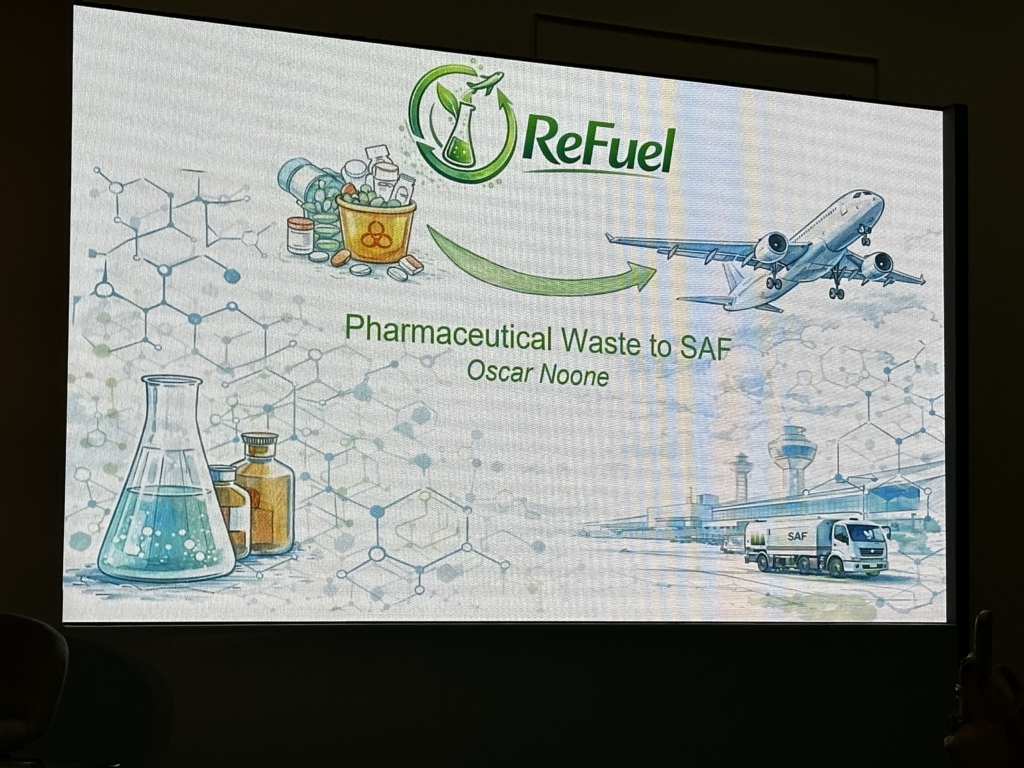
The core idea is to use solvent-rich waste streams from pharmaceutical manufacturing as a new feedstock for SAF production via the Alcohol-to-Jet pathway.
Pharmaceutical production is highly resource-intensive. According to the proposal, producing one kilogram of a pharmaceutical product can generate between 25 and 100 kilograms of waste, much of which contains usable solvents such as ethanol.
Currently, much of this waste is incinerated at significant cost, estimated at around £6,000 per tonne.
The proposed process would:
Extract ethanol from pharmaceutical waste streams
Purify it using centrifugation and phase separation
Refine it through fractional distillation
Feed it into existing AtJ SAF production pathways
Because the method builds on established certification routes, such as ASTM D7566, it could theoretically integrate into current fuel supply chains without requiring entirely new infrastructure.
Using Alcohol-to-Jet pathways to convert waste into sustainable aviation fuel
A key strength of the proposal is its compatibility with existing SAF technologies.
Rather than reinventing production methods, it focuses on introducing a new feedstock into the Alcohol-to-Jet pathway, which currently contributes only a small share of total SAF output.
By increasing ethanol availability, the concept could help scale AtJ production alongside more established pathways like HEFA and FT-SPK.
Challenges: consistency and energy intensity
The proposal also acknowledges several technical and commercial risks.
Feedstock variability remains a concern. Pharmaceutical waste streams may differ in composition and ethanol concentration, requiring careful selection of suppliers and consistent sourcing strategies.
Energy intensity is another challenge. Processes such as centrifugation and fractional distillation require significant energy input, which could affect overall lifecycle emissions and cost competitiveness.
To mitigate this, the proposal suggests:
Targeting ethanol-rich waste streams
Improving separation efficiency to reduce processing demand
Partnering with reliable, high-volume pharmaceutical producers
A multi-industry approach to net zero
Beyond aviation, the concept highlights the broader importance of cross-industry collaboration in achieving net zero.
By diverting waste from incineration and repurposing it into fuel, the approach could deliver emissions reductions in both the aviation and pharmaceutical sectors.
The proposal sets out ambitious targets, including contributing to a 1% increase in global SAF usage and achieving lifecycle emissions reductions of up to 80% compared to conventional jet fuel.
Noone outlined a three-stage roadmap:
Feasibility assessment, including waste stream analysis and logistics
Pilot-scale testing to validate conversion efficiency and costs
Integration into supply chains and expansion to other alcohol-based feedstocks
While still at an early stage, the idea reflects a growing shift in SAF thinking, from technology development to feedstock innovation.
Reducing waste and emissions through sustainable aviation fuel production
As aviation moves into what many describe as the “delivery phase” of decarbonisation, new ideas like this underline the role of emerging talent in solving entrenched challenges.
The feedstock bottleneck remains one of SAF’s biggest constraints. Proposals that unlock new, scalable and sustainable inputs could prove just as critical as advances in production technology itself.
