
US-made Hadley H13 rocket engine could power hypersonic aircraft and small rockets
A US-based aerospace and defense company has successfully carried out the first hot-fire tests of its upgraded Hadley H13 liquid rocket engine, which is developed for a number of applications, among which are hypersonics and light launch.
The H13 engine is the latest upgrade in Ursa Major’s Hadley rocket engine family. Designed at the company’s Colorado headquarters, it builds on the flight-proven Hadley H11, which has already powered hypersonic test flights.
The new upgrade features design improvements, updated materials, and refined production processes to increase both performance and reusability. The engine also uses new advanced technology to boost engine life.
Inside the H13 upgrade
Spagnoletti reported that the company produces major H13 engine components in-house. This vertical integration of 3D-printed parts ensures cost efficiency and streamlined manufacturing.
“With new materials and manufacturing, H13 can be reused more than twice as many times as previous variants, driving down the cost per flight while supporting new test objectives and mission profiles,” Spagnoletti explained.
According to the company, the Hadley H13 is designed as an off-the-shelf liquid rocket engine. This allows it to be integrated into multiple platforms without the need for custom engine development.
Credit: Ursa Major
Earlier versions of the engine were largely made for specific missions. This, in turn, increased development time and complexity. By contrast, the novel H13 offers a standardized propulsion solution capable of supporting diverse applications.
Ursa Major highlighted that the H13 also boosts overall reliability and operational flexibility while slashing production lead times. “With its increased reusability and cryogenic fuels, H13 is the lowest cost-per-flight and highest performing engine Ursa Major has developed to date,” the company said in a press release.
Designed for hypersonics
The Hadley engine is designed with 80% additive manufacturing. It enables rapid iteration, reduced part count, and accelerated production timelines. It delivers approximately 5,000 lbs of thrust at sea level. In vacuum conditions, this figure rises to roughly 6,500 lbs.
The system runs on liquid oxygen (LOX) and kerosene, and uses an oxygen-rich staged combustion cycle. “Hadley’s unprecedented innovation and success has set a new standard for agile, affordable propulsion in contested and commercial environments,” the company emphasized.
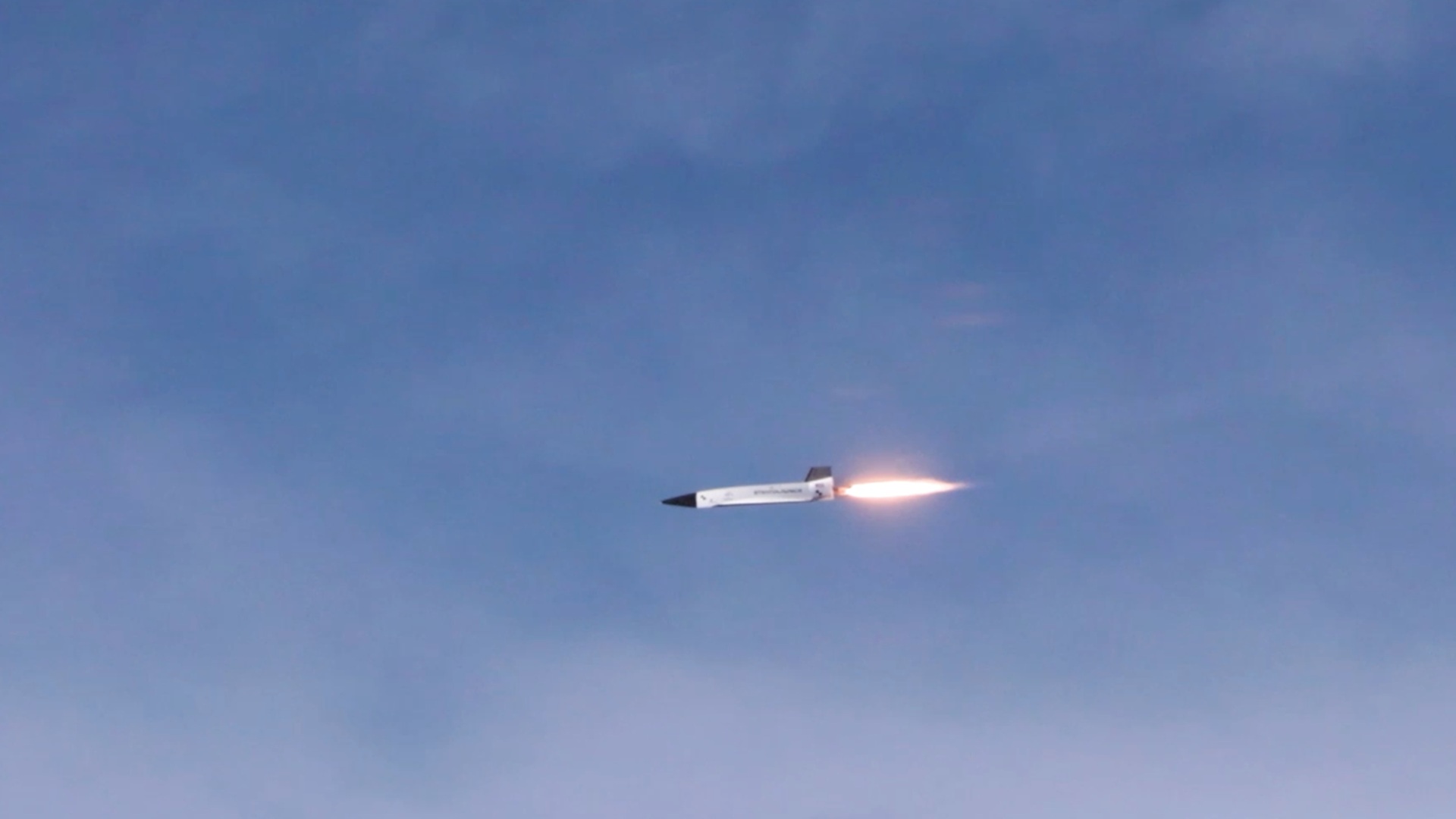
According to Ursa Major, the engine made its first flight in March 2024, powering Stratolaunch’s Talon hypersonic test vehicle. The flight took place over the Pacific Ocean off the coast of California. It marked the vehicle’s first powered flight.
The company said the aircraft reached high supersonic speeds approaching Mach 5, or five times the speed of sound. “Hadley is the first American-made propulsion engine of its kind to reach sustained Mach 5+ speeds and return, flying successfully with Stratolaunch’s Talon-A vehicle,” Ursa Major concluded.
Ursa Major utilizes advanced manufacturing and flexible system architectures to develop technologies for land, air, sea, and space applications. It aims to support and revitalize the defense industrial base for the US and its allies.
