
Senate committee advances NASA authorization bill that changes Artemis and extends ISS
WASHINGTON — The Senate Commerce Committee advanced a revised NASA authorization bill that implements some of the changes to the Artemis lunar exploration effort sought by the agency while also extending the life of the International Space Station.
The committee passed on a voice vote March 4 an amended version of S. 933, a NASA authorization act originally introduced nearly a year ago. The committee also approved nearly 20 additional amendments from various committee members with the same vote.
The new version of the bill supports changes that NASA is seeking to make to Artemis that NASA Administrator Jared Isaacman announced at a Feb. 27 briefing.
Sen. Ted Cruz, R-Texas, chairman of the committee, referred to those changes to Artemis in his opening remarks. “Today, the Commerce Committee will help guide those changes with the NASA Authorization Act,” he said. “Our bill authorizes critical funding for and gives strategic direction to the agency, in line with the priorities of Administrator Isaacman and the Trump Administration.”
At the Feb. 27 briefing, NASA announced it would not proceed with upgrades to the Space Launch System, sticking instead to a “near Block 1” version. In a March 3 statement, NASA confirmed that meant it no longer sought to develop the Exploration Upper Stage for the Block 1B version of SLS.
“Subject to the availability of appropriations, the Administrator may seek to identify and fund an alternative technology to replace the Exploration Upper Stage,” the Senate bill states, provided the administrator of NASA determines the stage is “unlikely to achieve the mission goals of the Artemis campaign.”
The bill would instead require NASA to provide a briefing on the issues the agency is facing trying to achieve a higher flight rate of the SLS and plans to address this with a “standardization” of the rocket.
Another section of the Senate bill authorizes NASA to develop a base on the moon, building on a provision in a White House executive order on space policy in December that called on NASA to establish the “initial elements of a permanent lunar outpost” by 2030.
“As soon as practicable, the Administrator shall undertake activities necessary to establish a Lunar Surface Moon Base to develop a permanent crewed United States presence on the Moon capable of long-duration habitation, robotic, and industrial operations to advance science, technology, and strategic interests,” the bill states.
The section includes some general goals for the base and guidelines for development, but few specifics such the composition of the base, schedule for its development or cost. The bill does direct NASA to select a lead center for the base’s development with a specific set of requirements that appear to be intended to ensure the program is run by the Johnson Space Center in Texas.
Although the bill includes extensive language about a lunar base, it says little about the lunar Gateway intended to operate in lunar orbit. While last year’s budget reconciliation bill provided $2.6 billion for development of the Gateway, a NASA infographic released Feb. 27 about its revised Artemis plans did not feature the Gateway even while including a lunar base.
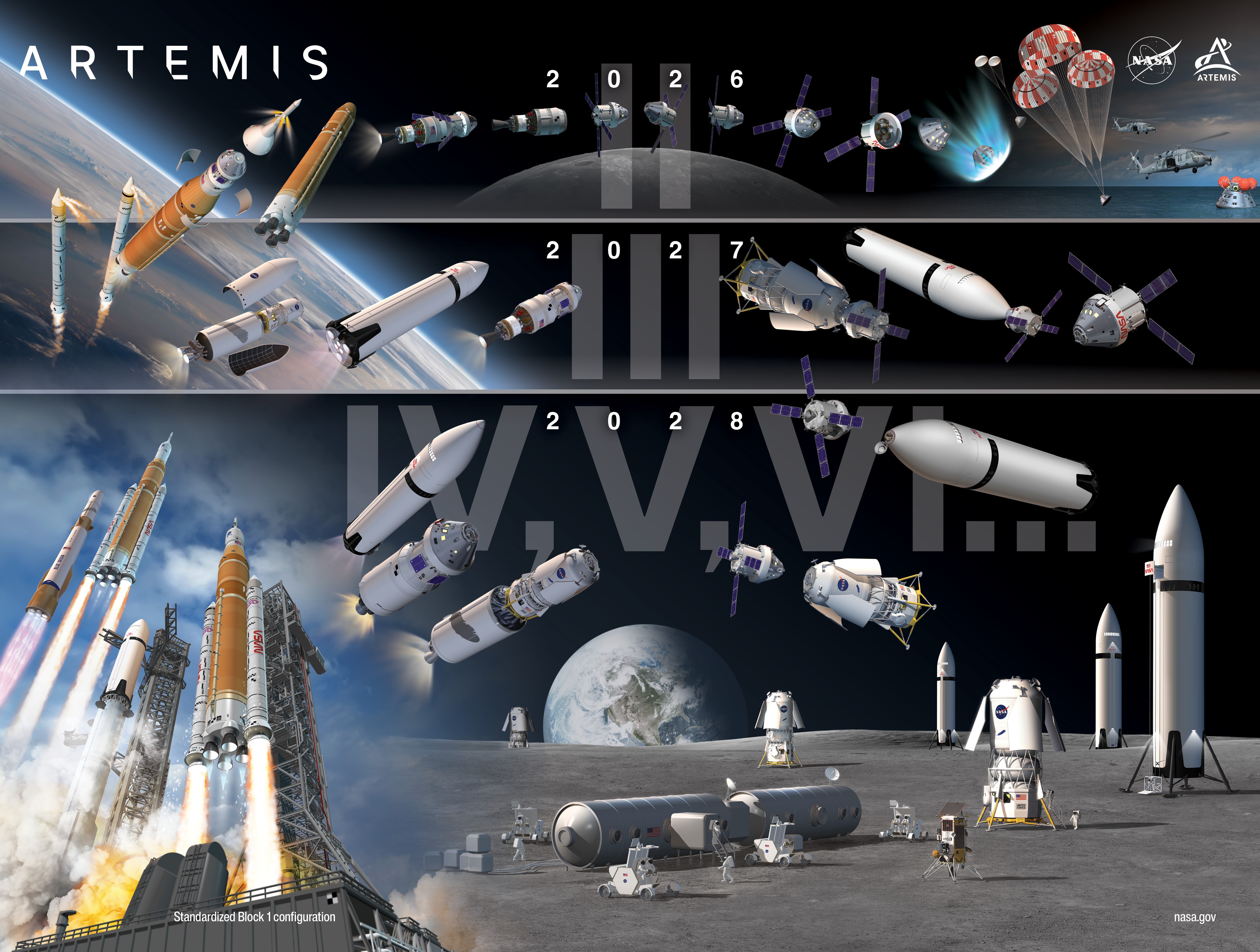
Regarding the Gateway, the bill states only that NASA will provide a briefing “on plans for the Gateway outpost” within 60 days of enactment.
ISS extension
Another portion of the bill addresses the International Space Station and plans for commercial space stations. Among the biggest changes is a two-year extension of the ISS lifetime, from the end of 2030 to the end of 2032.
The extension, the bill argues, is required because of delays in the Commercial Low Earth Orbit Destinations, or CLD, program, including postponing the release of a call for proposals for the next phase of the program.
“NASA has repeatedly delayed the release of a request for proposals for sustained commercial low-Earth-orbit services, and such delays, coupled with shifting requirements and inconsistent programmatic direction, have introduced substantial uncertainty into the development planning, financing, workforce scaling, and infrastructure investment decisions of commercial providers,” the bill states.
“As a result of such uncertainty and delayed procurement action, commercial providers have been unable to scale development and private investment at a pace aligned with the previously articulated NASA objective of de-orbiting the ISS in or around 2030,” the bill continues.
The bill directs NASA to maintain ISS operations at its current level, in terms of number of crew and cargo flights to support it. It instructs NASA not begin a transition from the ISS, and deorbiting of the station, until at least one commercial successor is operational. It also requires NASA to select at least two companies for the next phase of the CLD program.
Mars missions and studies
The portion of the bill dealing with NASA programs largely endorses ongoing missions. An exception is the Mars Sample Return (MSR) program, effectively canceled when it was not funded in the fiscal year 2026 appropriations bill enacted in January.
The Senate bill directs the formal termination of the earlier MSR program and calls for the creation of a new MSR effort. The new plan would have a total cost cap of $8 billion, although it was not clear if that included funds spent on the earlier MSR program. It would also require use of “existing flight-proven technologies” and limit international cooperation to contributions that do not “unduly increase” the cost and risk of the program.
The bill directs NASA to submit a plan for carrying out that revised MSR program, including cost and schedule estimates, within 120 days of enactment. It also states that the Mars Telecommunications Orbiter, funded in last year’s budget reconciliation bill, should remain separate from this revised MSR effort.
A later section of the bill requires NASA to perform studies of concepts for “Mars-focused missions” that could be launched on commercial heavy-lift vehicles.
One concept included the bill would send human tissues to Mars “for the purpose of studying biological and environmental effects on human tissue in the Martian environment.” A second concept would be focused on space weather measurements as well as physical and life sciences studies that could support future human Mars missions.
Launch briefings, not quotas
One provision not found in the bill approved by the committee dealt with limits on commercial launch contracts. According to industry sources who had seen earlier drafts of the bill, it included a provision that would have kept any single company from receiving more than 50% of overall value of launch contracts awarded by the agency in any year.
The proposal had the public support of former NASA Administrator Jim Bridenstine, whose work today includes serving as a lobbyist to United Launch Alliance.
“By capping any single launch provider at 50 percent of NASA’s total launch contract value, Congress is reinforcing competition and protecting the small and medium-sized manufacturers, propulsion companies, avionics developers, and suppliers that make up the backbone of America’s space enterprise,” he wrote in a social media post.
Others, including those commenting on his post, disagreed, arguing it would help companies unable to otherwise compete on a level playing field. The provision would have benefitted ULA as well as Blue Origin and potentially other launch providers at the expense of SpaceX, which has won the lion’s share of NASA launch contracts in recent years.
The bill approved by the committee did not include any restrictions on launch contracts. Instead, it endorsed a “competitive United States commercial launch marketplace” and called for a briefing by NASA on its “plans and strategy for continuing to procure commercial launch services.”
