
Rocket-powered Aurora spaceplane tracked by navy in New Zealand defence trial
A high-speed, rocket-powered spaceplane developed in New Zealand has been used in a live defence trial to test naval radar tracking, offering a glimpse into how reusable aerospace platforms could reshape future military experimentation.
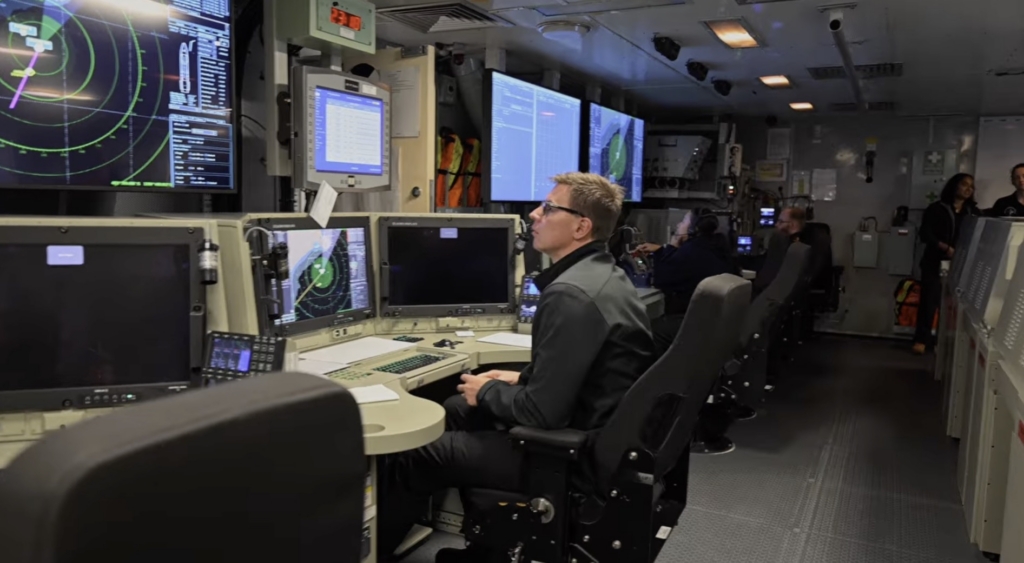
The trial, conducted off the coast of Banks Peninsula, brought together the Royal New Zealand Navy, Defence Science and Technology (DST), and Dawn Aerospace. Dawn’s suborbital spaceplane Aurora flew from the Tawhaki National Aerospace Centre while the frigate HMNZS Te Kaha tracked it at sea.
At its core, the experiment was designed to answer a practical question: how well can existing radar systems detect and track a fast-moving, high-altitude vehicle under realistic conditions? But the way that question was tested marks a broader shift in how such trials are now being approached.
DARTE trial tests naval radar tracking of Aurora spaceplane in real-world conditions
Unlike conventional trials that often rely on simulations or overseas test ranges, this exercise was conducted entirely within New Zealand’s own airspace and waters.
Aurora was flown in carefully designed flight profiles, allowing defence scientists to observe radar performance against a consistent, repeatable target.
The spaceplane reached speeds of around Mach 1.1 and climbed to approximately 25 kilometres, creating conditions that sit between traditional aircraft operations and near-space trajectories.
From the deck of HMNZS Te Kaha, naval radar systems tracked the vehicle throughout its flight, generating data that reflects real operational environments rather than controlled laboratory assumptions.
For defence planners, that distinction matters. Real-world testing introduces variables such as speed, altitude, and atmospheric effects that are difficult to replicate elsewhere but critical to understanding system performance.
Aurora spaceplane enables repeatable high-speed flight testing for defence systems
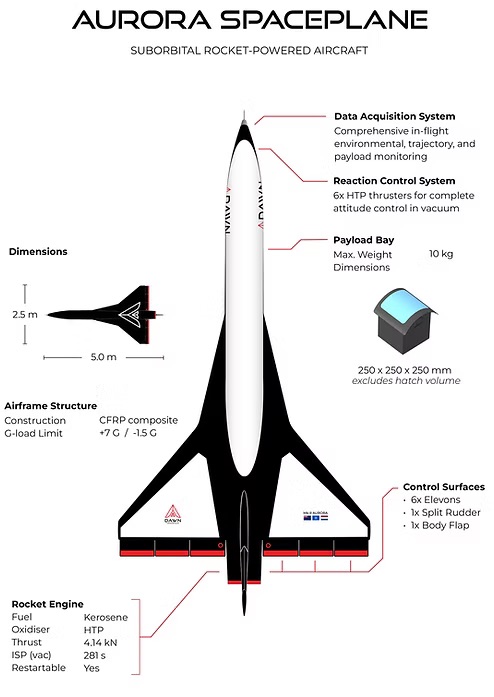
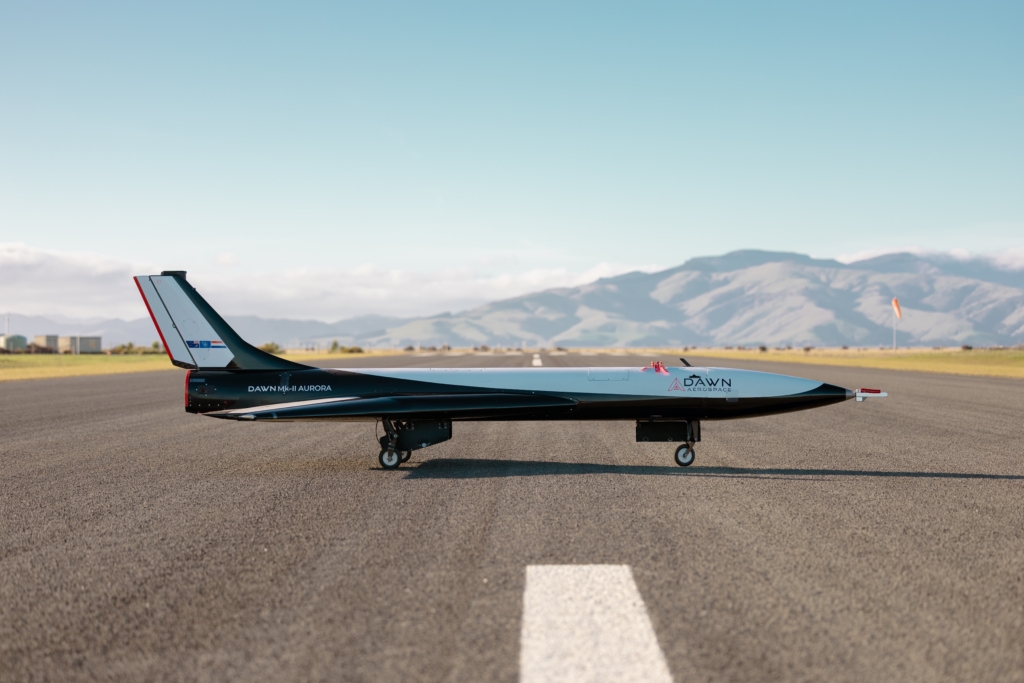
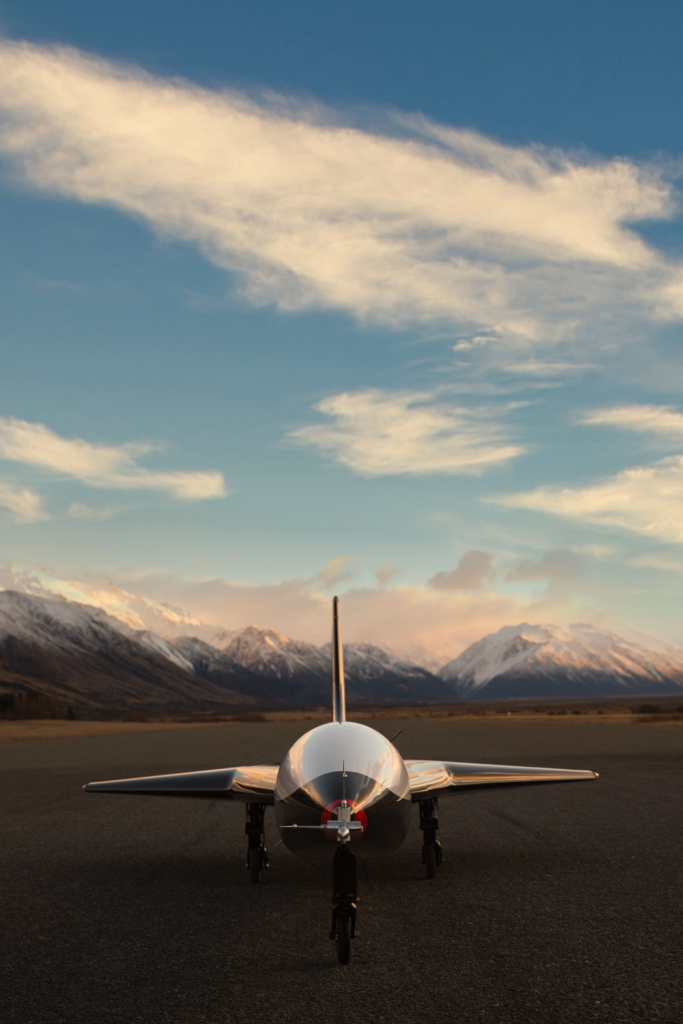
At the centre of the trial was Aurora itself, a compact 4.8-metre suborbital spaceplane designed for rapid reuse and consistent performance.
Unlike traditional test platforms such as one-off rockets or expensive manned aircraft, Aurora can fly repeated missions with near-identical profiles. That repeatability allows engineers to test systems multiple times under controlled conditions, refining data with each flight.
Dawn Aerospace chief executive Stefan Powell said the platform was developed to fill a gap that has long existed in aerospace testing.
“We built Aurora because few reusable platforms in the world can match this performance envelope,” he said, adding that it enables “a completely new level of rapid, repeatable testing” for both civil and national security applications.
That capability is particularly relevant as defence systems increasingly need to track faster, more manoeuvrable targets operating at higher altitudes.
Aurora spaceplane development targets near-space and hypersonic test capability
While the current version of Aurora operates in the upper reaches of the atmosphere, the platform is already evolving.
An upgraded variant, now under development, is expected to reach speeds of up to Mach 3.7-more than 3,800 kilometres per hour and climb beyond 100 kilometres, effectively entering the edge of space.

Such performance would place the vehicle in a category that overlaps with emerging threats and technologies, including hypersonic systems and high-altitude surveillance platforms.
For defence research, this offers a rare tool: a reusable vehicle capable of simulating complex, high-speed trajectories without the cost or logistical burden of traditional launch systems.
New Zealand conducts DARTE trial domestically to strengthen sovereign defence capability
Beyond the technical results, the location of the trial carries its own significance.
Historically, many countries have relied on overseas ranges for advanced aerospace testing, particularly when dealing with high-speed or near-space systems. By carrying out the DARTE experiment domestically, New Zealand avoided that dependency.
David Galligan, Director of Defence Science and Technology, said the trial demonstrated the value of aligning national infrastructure, defence expertise and industry capability.
“DARTE shows the value of New Zealand industry, defence capability and national infrastructure working together with purpose,” he said.
He added that conducting such work locally strengthens sovereign capability, allowing the defence establishment to generate and control its own data.
That point is increasingly relevant as access to international testing environments becomes more competitive and politically sensitive.
Reusable spaceplanes like Aurora reshape defence testing and radar evaluation
The use of Aurora in this trial reflects a wider change underway in defence experimentation.
Traditional testing methods like relying on large aircraft, missiles or single-use systems are often costly, inflexible and limited in frequency. Reusable platforms introduce a different model: one where systems can be tested repeatedly, quickly and at lower cost.
Aurora’s ability to deliver consistent flight profiles makes it particularly suited to evaluating radar systems, sensor performance and tracking algorithms under varied conditions.
It also allows defence organisations to simulate emerging threats more realistically, without needing to deploy operational assets or rely on external partners.
In that sense, the platform is not just a test vehicle but part of a broader shift towards more agile, data-driven capability development.
New Zealand aerospace industry expands role in defence testing and national security
The trial also highlights a wider question facing New Zealand: whether such high-value aerospace work can move beyond isolated demonstrations and develop into a sustained industrial capability.
The collaboration between Dawn Aerospace, the Navy and defence scientists suggests that the foundations are already in place.
Powell noted that demonstrating the capability in partnership with the New Zealand Defence Force could open the door to similar operations internationally, positioning the country as a provider of specialised testing services.
At the same time, officials see the programme as a way to retain investment within the domestic economy while building technical expertise that can support both defence and commercial applications.
