
Noemi Reveals Multi-mission Strategy for Electric Amphibious Aircraft
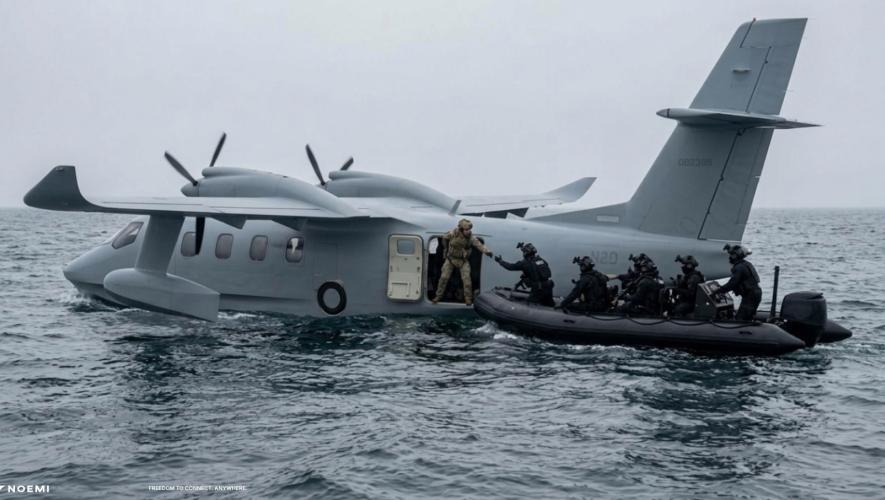
Noemi Aerospace, the Norwegian electric seaplane developer that rebranded from Elfly Group in February, has started construction on its first full-scale prototype and unveiled a strategy to adapt the same airframe for aerial firefighting, skydiving, and military missions.
The Norwegian start-up, which has been developing its nine-passenger Noemi electric amphibious aircraft since 2021, announced the expanded strategy on May 19 alongside a program update. Construction of the TAC-1 experimental prototype is underway following a preliminary design review completed in March, company officials told reporters in a virtual news briefing on May 19.
“By designing and then certifying Noemi, we don’t just create a single aircraft—we create a platform that we can then develop,” chief engineer Simon Bendrey said in the briefing.
Co-founder and chief technology officer Tomas Brødreskift said wing tooling has begun, and detailed design work is underway across multiple subsystems. TAC-1 will be powered by commercial off-the-shelf automotive motors, inverters, and battery hardware integrated with an in-house gearbox and governor system, Brødreskift said, adding that a ground test rig is under construction and expected to run a propeller by the end of the third quarter.
Noemi also announced two senior hires this year. Bendrey joins as chief engineer after working on Airbus programs, including the A350 and A400M, the AeroMobil flying car, and Dufour Aerospace’s tiltwing eVTOL. Le Cardinal’s hiring was disclosed in briefing materials; Hugues Le Cardinal, former head of airworthiness and certification at France’s Direction Générale de l’Aviation Civile, has joined as head of airworthiness.
Bendrey said the seaplane mission is better matched to current electric propulsion technology than the eVTOL programs he previously worked on. “The seaplane mission being under an hour is absolutely right for the first electrification, and it suits today’s technology, whereas certainly in the eVTOL world we were hoping that technology would catch up to what we would like to do,” he told reporters in the briefing.
According to performance figures presented at the briefing, the core aircraft is a 100% battery-electric flying boat seating nine passengers and one or two pilots, with a maximum takeoff weight of 5,670 kilograms and a cruise speed of 108 knots. Noemi says its flying-boat hull geometry achieves a lift-to-drag ratio of 16, compared with eight for the amphibious Twin Otter DHC-6-300, cutting cruise power from roughly 1,000 kilowatts to 330 kilowatts—enough for roughly 200 kilometers of range on battery power alone.
The same airframe, with propulsion-system swaps and fuselage modifications, could accommodate hybrid-electric or conventionally powered configurations, according to the company. A hybrid variant could extend range to around 600 kilometers; a conventionally powered version could carry seven to 14 passengers up to 2,000 kilometers.
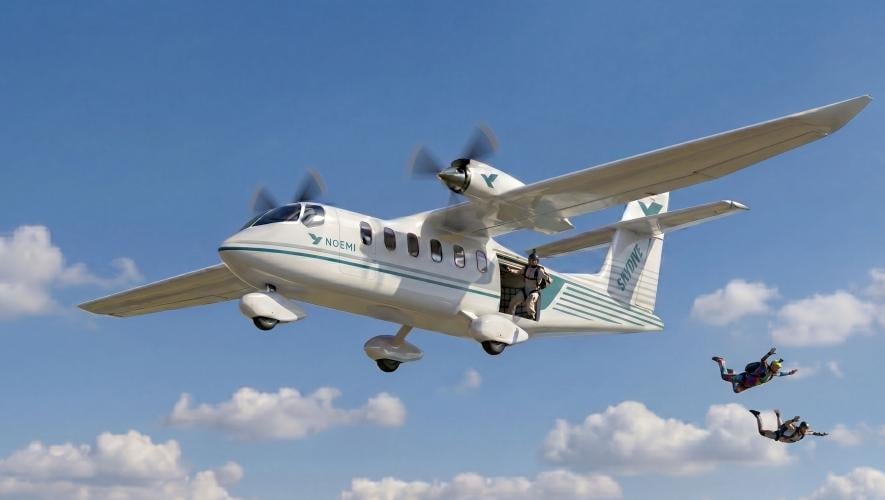
For the skydiving market, Noemi is targeting a land-based variant configured to carry 17 to 20 jumpers to 15,000 feet. Noemi said the aircraft could be recharged in 10 minutes for a fast turnaround. A water-scooping firefighting variant would carry roughly 2,700 kilograms of retardant, scooping from lakes or coastal water, according to the company. Search-and-rescue, medical evacuation, cargo, and military reconnaissance round out the potential applications.
Lithun told reporters that roughly 70 prospective customers have signed non-binding expressions of interest—memorandums of understanding and similar agreements that indicate intent to purchase but carry no contractual obligation—including Nordic Seaplanes, Loch Lomond Seaplanes, Vet Airways, and UrbanLink, all of which signed under the Elfly name. None have been converted to firm purchase agreements.
Noemi is pursuing type certification under EASA’s CS-23 Level 3 rules, which cover aircraft with up to nine passenger seats. At the current maximum takeoff weight of 5,670 kilograms, this represents a change from the company’s original plan to pursue Level 4 certification from the outset. Noemi now plans to seek Level 4 certification, which would allow up to 19 passengers, two to three years after the initial type certificate. The airframe is structurally sized to support the higher weight required by the classification. Noemi continues to work under a pre-application contract with EASA signed in June 2025.
First flight of the TAC-1 experimental prototype is targeted for the fourth quarter of 2027, with commercial operations planned for 2030, according to Noemi. Lithun said that the full program will cost approximately $150 million USD, with roughly $80 million needed to reach type certification. About $20 million has been raised to date, including roughly $10 million from the Norwegian government, and a Series A round is in progress.
