
Making Firefly worth flying
MALAYSIA Aviation Group Bhd (MAG) is weighing the future of its low-cost arm FlyFirefly Sdn Bhd (Firefly) as persistent technical problems, an ageing fleet and weak financial performance raise questions over whether the airline can remain viable in its current form.
Firefly currently operates nine ATR 72-500 turboprops out of Sultan Abdul Aziz Shah Airport in Subang, Selangor (Subang Airport), and five Boeing 737-800 narrowbody jets from Kuala Lumpur International Airport (KLIA).The leases on the 737-800s are due to expire from early 2027, giving parent MAG a key decision point on whether to renew or replace the aircraft.
Firefly’s future is being considered against a challenging backdrop. Malaysia’s aviation industry is facing higher operating costs due to the prolonged Middle East conflict, aircraft delivery delays caused by supply chain disruptions and intensifying competition. Firefly passengers have also endured repeated cancellations and delays over the past two years as the airline struggles to manage an ageing fleet.
The difficulties have fuelled talk that MAG could shut down the carrier after years of losses.
But in an interview with The Edge in August, MAG president and group CEO Captain Nasaruddin A Bakar said Firefly remained part of the group’s strategy despite its financial losses. Malaysia Airlines is aimed at the premium market while Firefly is intended to serve the leisure, value-oriented and low-cost segments, he said.
The key question is whether Firefly can be made financially sustainable without becoming a permanent burden on its parent.

Turboprops versus jets
“The decision to shut down Firefly is part of a two-part review looking separately at the turboprop and jet operations,” says Brendan Sobie, an analyst and consultant at Singapore-based aviation consultancy Sobie Aviation.
He says four broad scenarios had previously been considered: retaining both operations, closing both or retaining only one of the two, with a decision expected by the end of the year.
“However, given the current situation at AirAsia Group Bhd (KL:AAGB), it would be sensible to delay the decision on the jet operation until it is clear what happens at AirAsia Group or Malaysia AirAsia. If AirAsia shrinks or does not fully restore its capacity, the outlook and strategic importance of Firefly’s jet operation could change,” Sobie tells The Edge.
Firefly’s poor financial performance is only part of the equation.
“While the current fuel crisis has made the financial performance even worse, this review has to take into account the longer-term strategic implications of both turboprop and jet operations to MAG as a company and to Malaysia overall, given that MAG is a state-owned entity,” says Sobie. MAG is controlled by sovereign wealth fund Khazanah Nasional Bhd.
Jet fuel prices have soared from US$85 to US$90 per barrel to above US$200 following the outbreak of the Iran war in February. They averaged US$185.43 per barrel in the week ended Sept 25, according to the S&P Global Platts Jet Fuel Price Monitor.
The turboprop fleet presents a more immediate question.
“If the decision is to retain the turboprop operation, the nine ATR 72-500s will eventually have to be replaced. MAG would therefore need to look at placing a new order for ATR 72-600s, given that all eight of its outstanding ATR 72-600 orders from a 2013 deal were transferred to AirBorneo as part of the Sarawak government’s acquisition of MASwings Sdn Bhd,” Sobie says. The acquisition was completed in January this year.
The jet operation offers MAG more flexibility.
Although Firefly’s 737-800s will also eventually need replacing, Malaysia Airlines already operates the same aircraft type. That gives the airline group more options in terms of fleet commonality and deployment, Sobie adds.
Firefly is often compared to Singapore Airlines Ltd’s budget offshoot Scoot Pte Ltd which has managed to be profitable.
To Sobie, the comparison is limited.
“Scoot is a much larger low-cost carrier, with more than 60 aircraft feeding SIA at Changi Airport. By contrast, Firefly has only five jets. Scoot also has no turboprop operation and is based entirely out of Changi Airport rather than a combination of Subang and KLIA,” he says.
Subang is central to ATR business
Firefly’s turboprop operation’s biggest competitive advantage is its ability to fly shorter and thinner routes, such as Alor Setar, Johor Bahru, Kuching, Langkawi, Kuala Terengganu, Penang, Kota Bharu and Singapore’s Seletar Airport. The ATR is particularly suited to routes where demand is not strong enough to support larger jets while allowing airlines to offer relatively frequent services.
An industry expert says this gives Firefly a distinct niche as the largest turboprop operator in Peninsular Malaysia. Berjaya Air also operates ATR aircraft from Subang Airport, primarily serving destinations linked to Berjaya Group’s portfolio of hotels and resorts.
According to the industry expert, the appeal of Firefly’s Subang-Seletar service, for example, is not necessarily the lowest fare but convenience. Travellers can reach the airports relatively easily and arrive closer to departure time than they might at KLIA or Changi Airport.
“If Firefly decides not to continue with the jets in KLIA but just to keep ATRs and fly out of Subang airport, will that work? Will that make them profitable? Yes, it should,” the industry expert says.
The argument is that a newer ATR fleet could allow Firefly to increase frequencies, expand its network and improve reliability while concentrating on a relatively narrow market.
Sobie says Firefly’s turboprop operation has historically performed better than its jet business, although competition from other jet operators since the resumption of jet services at Subang Airport in 2024 and higher fuel costs have altered the economics.
The current ATR 72-500s are also ageing and increasingly expensive to operate. If MAG decides to retain the turboprop business, the fleet will eventually have to be replaced, he adds.
MAG is understood to be weighing whether to order new ATRs or switch to another aircraft type. Either option would require advance planning, given the significant order backlogs facing aircraft manufacturers.
Embraer is also actively marketing its regional jets in Asia, offering an alternative for airlines seeking aircraft positioned between turboprops and larger narrow-body jets. Scoot, for example, operates the 112-seat Embraer E190-E2 jets.

Can Firefly survive without jets?
There is less agreement over whether a turboprop-only Firefly could become a sustainable business.
Shukor Yusof, founder and analyst at aviation consultancy Endau Analytics, says retaining Firefly makes strategic sense because it gives MAG a low-cost platform alongside Malaysia Airlines.
He says closing Firefly altogether would leave Malaysia Airlines without a dedicated low-cost platform and reduce competition in the domestic market.
“I don’t think at this stage, having Firefly would come close to even competing against AirAsia, even though AirAsia is right now struggling. But if you do away with Firefly, then you lose a tool to give an option to Malaysians, for example, to have another alternative carrier,” he says.
In Shukor’s view, however, Firefly has never been developed into a sufficiently strong competitor to AirAsia.
“There is an argument to be made about closing it down because it has not really been an effective airline in its current position,” he says, adding that MAG needs to rethink Firefly’s business model.
He is also sceptical that an ATR-only operation could become a meaningful low-cost carrier.
“You cannot make money on just ATR turboprops. Very difficult,” says Shukor.
A turboprop fleet would largely confine Firefly to Peninsular Malaysia. A larger narrow-body fleet would give it the ability to connect the peninsula with Sabah and Sarawak and operate longer routes.
Shukor also argues that Firefly should not be assessed solely through the lens of its stand-alone profit and loss. Its strategic value to Malaysia’s aviation system, including its relationship with Malaysia Airlines and its role in providing competition to AirAsia, also needs to be considered.
The Subang Airport dilemma
Firefly’s future is closely tied to the government’s plans for Subang Airport.
Since the resumption of jet services in 2024, Subang Airport has been positioned as a potential premium and regional aviation hub. But restrictions on jet movements, parking and operating hours have limited airlines’ ability to build scale.
Industry observers say those restrictions have also contributed to intense competition for a relatively limited pool of passengers, making it difficult for airlines to build the capacity and frequency needed to command a premium.
Firefly’s own experience illustrates the problem. The airline began jet operations from Subang Airport in August 2024 but ended the service exactly a year later amid financial losses linked to the airport’s structural limitations.
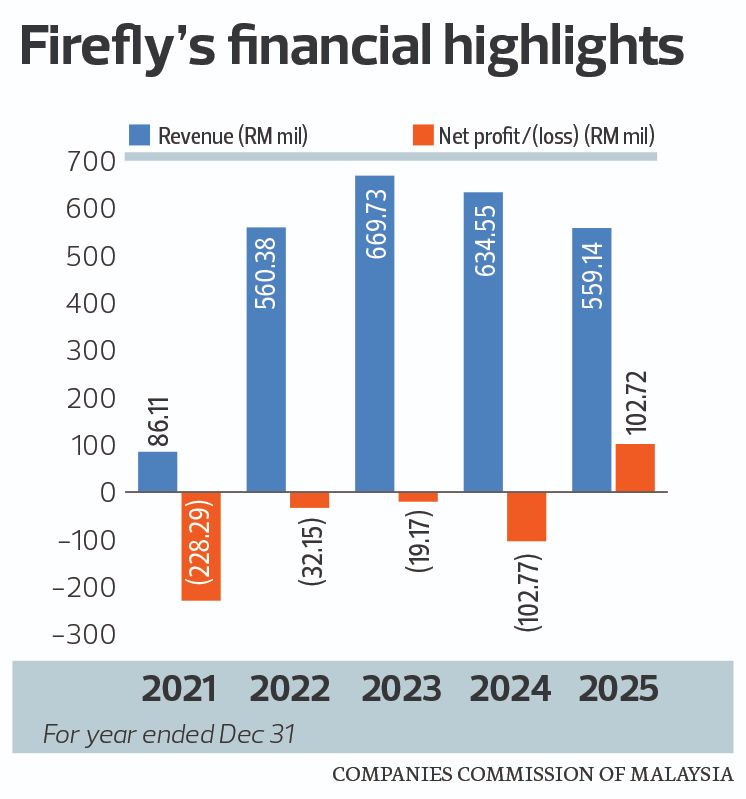
Companies Commission of Malaysia data show that Firefly’s net loss widened sharply to RM102.77 million in the financial year ended Dec 31, 2024, from RM19.17 million in the previous year.
Firefly reported a net profit of RM102.72 million in FY2025, largely because of gains from the disposal of MASwings to the Sarawak government.
Still, the industry expert believes that Subang Airport remains valuable precisely because of its location and convenience. Firefly could potentially dominate the airport’s short-haul niche if it has enough aircraft and a reliable fleet.
The question, therefore, is not simply whether Firefly is profitable today but whether the airline can be reconfigured to exploit the market it occupies.
Firefly’s future has become a debate over strategy as much as profitability.
The airline has changed its network and fleet strategy several times, including attempts to operate jets from Penang, Kota Kinabalu, Kuching and Subang before moving the current jet fleet to KLIA, Sobie notes.
That history has made it difficult to establish a consistent business model while the ageing fleet has constrained capacity and increased maintenance costs.
The industry expert says Firefly’s past operational problems forced MAG to be cautious about adding capacity. A newer fleet could allow the airline to increase aircraft utilisation and frequencies without exposing the group to the same level of disruption.
For MAG, that leaves a difficult balancing act: preserving Firefly as a strategic tool while preventing it from becoming a permanent financial burden.
MAG must determine whether the ATR business can justify a new fleet investment, whether the KLIA-based jet operation can achieve sufficient scale and whether either business can generate acceptable returns within the group’s broader aviation strategy.
For now, Firefly’s turboprop operation remains at Subang Airport and its jet operation at KLIA while the future of both fleets is still under review.
