
Jets, drones could become highly maneuverable using design, flight lessons from hawks
A study in the United States analyzed flight patterns of birds, and it could help make new designs of flying objects, such as jets or drones.
Researchers from the University of Oxford and the University of California, Davis, used a combination of motion capture and wind tunnel modeling to see how a Harris’s hawk changes its wing and tail shape as it flies through a narrow gap.
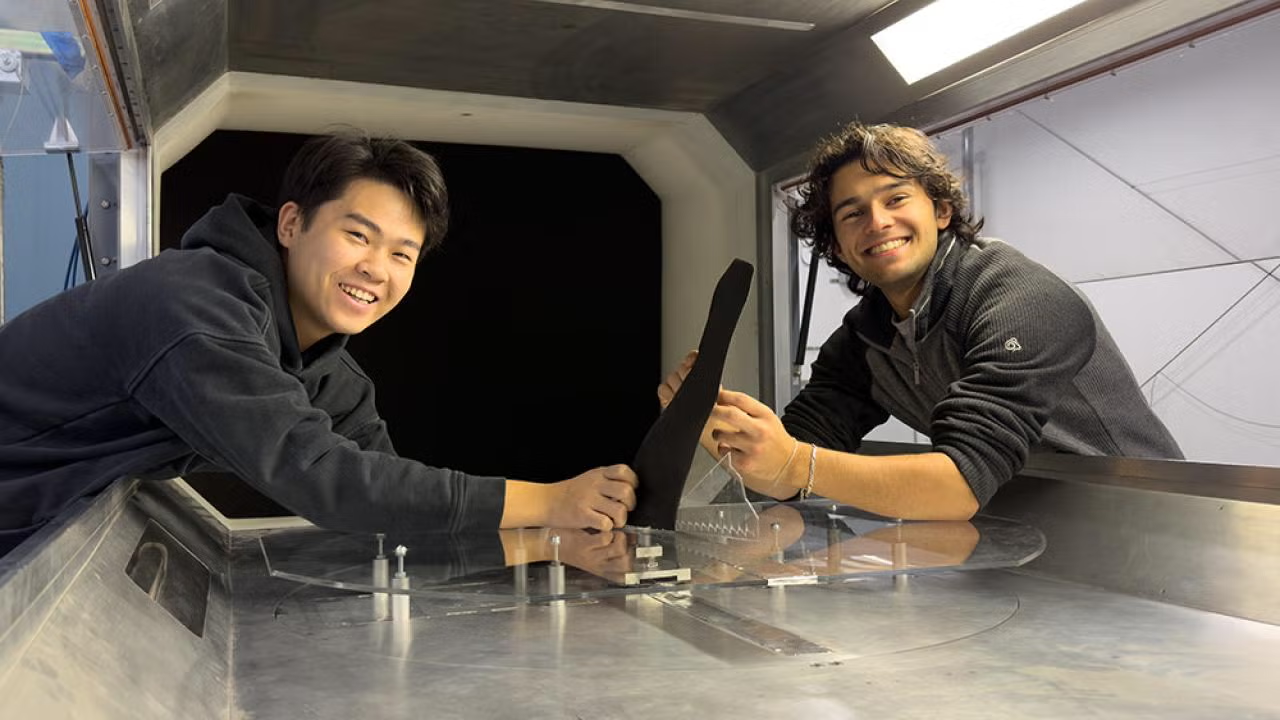
The team set up a 3D printed model of a hawk wing for testing in the UC Davis wind tunnel. Based on motion capture imaging at Oxford University, the wind tunnel model shows how a Harris’s hawk changes aerodynamic stability as it flies through a gap. The team claimed that the study of this type can give insight into aerodynamics that could be applied to uncrewed aerial vehicles.
The team found that when the hawk tucks its wings, it shifts from an unstable to a stable state. In aerodynamics, being unstable makes a flying object highly maneuverable, like a jet fighter, while being stable means it can maintain a steady course.
Motion capture imaging
The researchers used motion capture imaging at Oxford’s flight hall to film a Harris’s hawk gliding from one perch to another. They placed a pair of soft poles in the flight path to create a narrow gap, encouraging the bird to tuck its wings as it flew through, according to a press release.
After analyzing the video, they constructed models of the hawk’s wing and tail at different points in the maneuver and tested them in the wind tunnel facility at the UC Davis College of Engineering. Models were made from resin 3D printing thanks to support from the UC Davis Engineering Student Design Center, as per the release.
Progression of wing and tail configurations
Published in Journal of the Royal Society Interface, the study analyzed the progression of wing and tail configurations of a free-gliding Harris’s hawk (Parabuteo unicinctus) during a wing-tucking manoeuvre.
“Wind tunnel experiments on three-dimensional-printed models revealed that tucked configurations were statically stable, while spread configurations displayed a nonlinear relationship between pitching moment and lift,” said researchers in the study.
“This nonlinearity allows configurations to be either stable or unstable depending on the lift state, affording a previously under-explored source of flight performance flexibility.”
Birds control their flight differently from traditional aircraft
The team revealed that Harris’s hawks hunt as a team, often flushing out prey and flying around trees and cacti. Like most birds, they can rapidly shift from gliding flight to tucking in their wings to avoid obstacles.
The findings of the study suggest that birds control their flight differently than traditional aircraft, as human-built aircraft usually do not shift between stable and unstable states in this way.
“We found that the hawk transitioned from an unstable, spread configuration to a stable, tucked configuration as it traversed the gap, shifting the effective static margin from −25% to 19% of the reference chord,” said researchers in the study.
This outcome will advance novel bio-inspired, fixed-wing uncrewed aerial vehicle designs capable of rapid transitions, according to the study.
