
Iran attacks Azerbaijan airport with long-range Arash-2 kamikaze drones
Today marked another escalation in the Iranian war, with Iran launching one-way attack drones at Azerbaijan’s Nakhchivan International Airport, with another falling near a school. This remains a developing story, and details are still coming in.
Iranian drone attacks Azerbaijan airport with Arash-2 drones
Videos merged online showing one-way attack drones targeting Azerbaijan’s Nakchivan Airport, reportedly causing a couple of serious injuries.
The Azeri MoD posted on X (formerly Twitter), “Armed forces of Iran attacked Nakhchivan International Airport and other civilian infrastructure using UAVs. We strongly condemn attacks against Azerbaijan’s civilian infrastructure.”
It added “Retaliatory measures to defend the country’s territorial integrity and sovereignty are being prepared,” although it didn’t say what those retaliatory measures would be.
Initial reports of an attack by a Shahed-style drone were later replaced by confirmation that it was an Arash-2 that hit the facility. Iran has denied it is behind the attack.
| Drone | Typical role | Warhead | Range |
|---|---|---|---|
| Shahed-136 | Mass swarm, saturation attacks | ~30–50 kg | Hundreds to ~1,000 km |
| Arash-2 | Long-range precision strike | Up to ~150 kg | Up to ~2,000 km |
The Arash-2 is a long-range one-way attack (kamikaze) drone with a strike range of roughly up to 2,000 km and a large warhead, reportedly around 150 kg. The UAV is more akin to a low-cost cruise missile than a disposable swarm drone.
Iran typically uses Shaheds for cheap, mass attacks, intended to disrupt and confuse. Using the Arash-2 suggests a more deliberate, higher-value strike, and a marked demonstration of its capabilities.
After years of modernisation and its successful wars with Armenia, Azerbaijan is regarded as having a particularly competent military for the region.
The Azeri Air Force is made up of legacy Soviet-origin MiG-29s and Su-25s with a limited number of lower-end Sino-Pakistani JF-17 Thunders now in inventory.
Where the Azeri forces lack in fighter jets, they make up for in advanced attack drone capabilities, including an assortment of Turkish and Israeli drones.
The Iranian attack on Azerbaijan means that Iranian missiles and/or drones have now targeted Kuwait, Qatar, Saudi Arabia, the UAE, Oman, Jordan, Israel, Iraq, Syria, Turkey, and Azerbaijan so far. A Qatari F-15 even shot down a pair of Iranian Su-24s on their way to attack a US airbase in the country.
Azerbaijan is a vital international air corridor
It is unclear how the situation will escalate, but for international aviation, this could be particularly worrying. With the airspace closed over much of the Middle East and over Russia for many airlines, Azerbaijan has become a critical air corridor linking Europe and Asia.
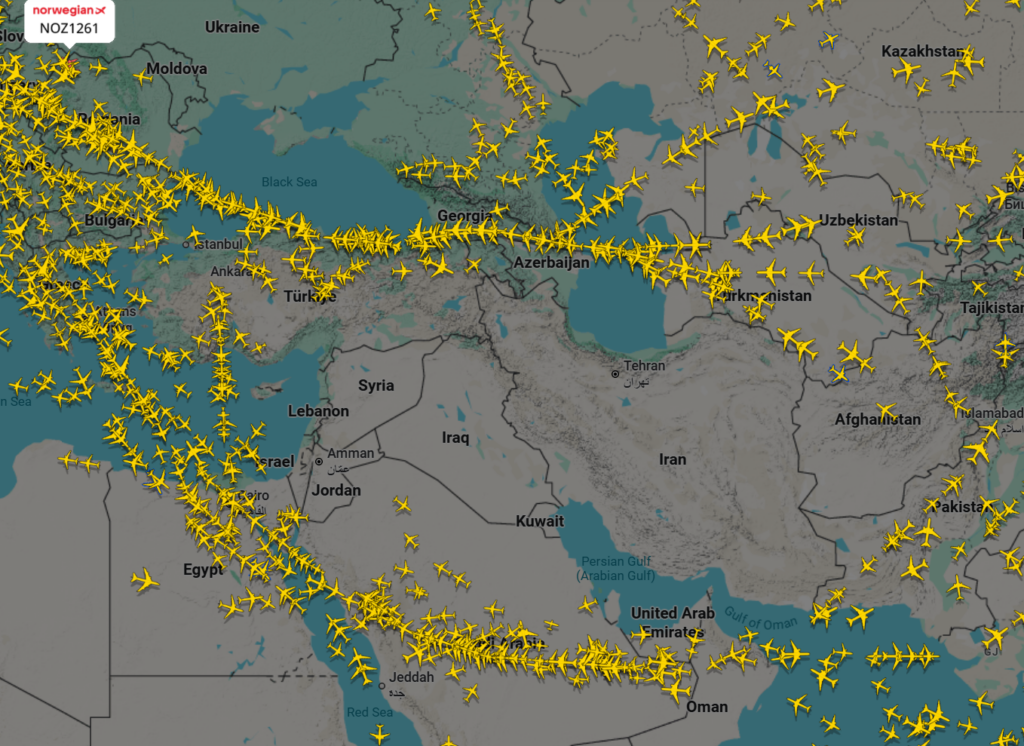
The Caucasus corridor is now the only safe passage between Russia/Ukraine and Iran/the Gulf.
This is not the first time Azerbaijan has seen war spill over from its two neighbouring and ongoing wars. In late 2024, Russian air defence shot down Azerbaijan Airlines Flight 8243 as it flew to Russia’s Republic of Chechnya. Vladimir Putin formally apologised to Azerbaijan in 2025.
But while the Russian shootdown of the Azeri civil airliner was accidental, today’s attack on Nakhchivan was deliberate.
Complicated relationship between Iran and Azerbaijan
The incident comes as the Iranian regime, struggling for survival, is lashing out at most of its neighbours. Yesterday, an Iranian missile was also intercepted over Turkey’s Hatay region.
Azerbaijan has long had a complicated relationship with Iran, something made more acute by more ethnic Azeris living in Iran than in Azerbaijan. Azerbaijan has also enjoyed a close relationship with Israel for years, and Israeli weaponry was central in the modernisation of Azeri forces and the defeat of Armenia in the Nagorno-Karabakh wars of 2020 and 2023.
Before the current US and Israeli strikes on Iran, there had been tensions between Azerbaijan and Iran that threatened to spill over into conflict. At one point in November 2020, Iran even released an image showing Azerbaijan’s president, Ilham Aliyev, in the crosshairs of a sniper as he visited the border.
Azerbaijan had been trying to remain neutral in the current Iran conflict with Aliyev, even sending his condolences for the death of Iranian Supreme Leader Ali Khamenei early in the campaign. However, it may be the next country drawn into the conflict.
