Hermeus Breaks Sound Barrier with Uncrewed Quarterhorse
Hermeus has pushed its Quarterhorse Mk 2.1 past the sound barrier, reaching Mach 1.21 during its third test flight at Spaceport America in New Mexico.
The Atlanta-based company announced the milestone on Monday, describing it as the first supersonic flight by a privately developed uncrewed aircraft. Conducted over New Mexico’s White Sands Missile Range airspace, the flight took place less than three months after Mk 2.1’s first flight in early March and 364 days after the inaugural flight of the original Mk 1.
“This flight demonstrates a pace of execution that is extremely rare in modern aviation,” said AJ Piplica, co-founder and outgoing CEO of Hermeus. “Our country’s ability to deliver new asymmetric military capability at scale depends on teams that can solve hard technical challenges quickly. That’s exactly what we’re proving with each test flight we conduct and each new aircraft we build at Hermeus.” (Hermeus announced on May 11 that company president Zach Shore will succeed Piplica as CEO on June 1, with Piplica moving to executive chairman.)
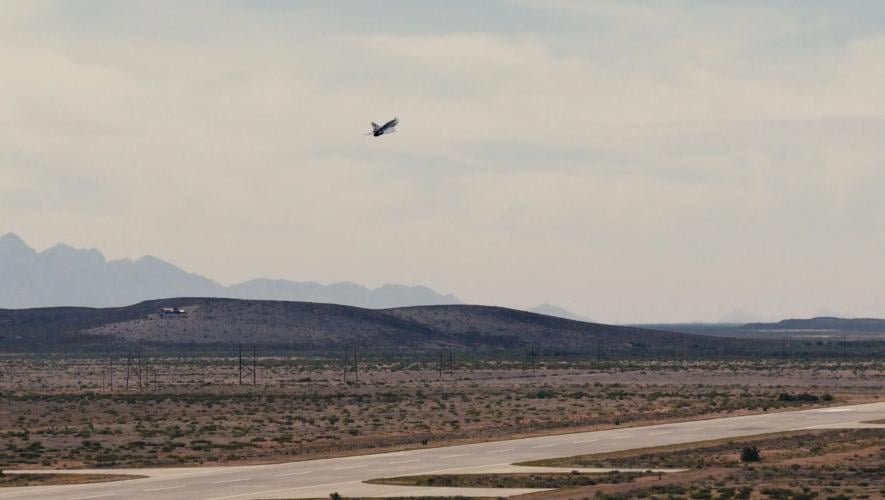
The delta-winged, F-16-scale Mk 2.1 flies on a modified afterburning Pratt & Whitney F100 engine. Hermeus is already building the Mk 2.2, which is intended to fly on the company’s Chimera II turbine-based combined cycle propulsion system, with the Mk 2.3 “soon to follow,” the company said.
Hermeus is developing Quarterhorse in collaboration with the Department of Defense as a precursor to its Darkhorse hypersonic military aircraft and, ultimately, the 20-passenger Halcyon civil hypersonic jet. While supersonic flight exceeds Mach 1, hypersonic flight—Hermeus’ ultimate goal—begins at Mach 5, enabling intercontinental travel in a fraction of current flight times.
The milestone comes as supersonic development activity intensifies across the industry. Boom Supersonic’s crewed XB-1 demonstrator broke the sound barrier at Mach 1.122 in January 2025, paving the way for the 64- to-80-passenger Overture airliner it claims could enter commercial service around 2029. Hermeus’ Mach 1.21 top speed surpasses XB-1’s mark. Meanwhile, NASA’s X-59 quiet supersonic research aircraft, built by Lockheed Martin, has completed 16 test flights and is targeting its first supersonic attempt as early as next month.
