
Could the PLA’s new shipborne drone redefine naval operations in the South China Sea?
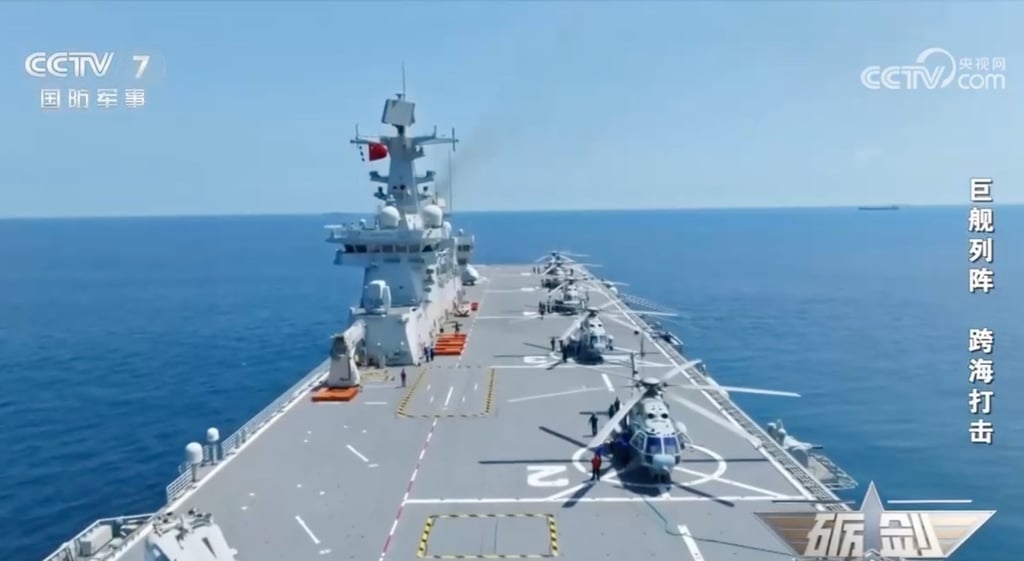
A new type of autonomous helicopter has been seen operating on the Type 075 amphibious assault ship, possibly improving the People’s Liberation Army’s (PLA) capabilities in the Taiwan Strait and the South China Sea.
The Type 075 has a displacement of between 35,000 and 40,000 tonnes and is designed to transport landing craft, troops, armoured vehicles and helicopters.
Chinese media often refer to the vessel as a helicopter carrier or light aircraft carrier. The ship can carry more than 30 helicopters and simultaneously launch and recover six.
In 2020, a model of an uncrewed helicopter, thought to be the AR-500C – the AR-2000’s predecessor – was spotted on the deck of the Type 075 ship.
Fu Qianshao, a retired PLA Air Force colonel, said the small size of the new uncrewed helicopter meant its take-off and landing area was small, allowing ships to carry and launch more uncrewed helicopters simultaneously.
“Its performance should be close to that of crewed helicopters but with a higher level of automation,” Fu said.
Analysts also said the uncrewed helicopter would be better adapted to battlefield environments, overcoming the limitations of human pilots.
According to Song Zhongping, a military analyst and former PLA instructor, this type of drone could “operate in nearly all weather conditions”.
“Crewed helicopters have more limitations,” Song said. “They cannot take off or land in some bad sea conditions and weather situations.
“This uncrewed helicopter should also serve as a reference for damage assessment of crewed helicopters and extend their reconnaissance and kill range.”
Yue Gang, a retired PLA colonel and prominent commentator, said uncrewed helicopters could be used to perform dangerous reconnaissance and strike missions.
“Drones can be deployed more frequently, without the need to consider personnel load,” Yue added.
Yue said the aircraft’s autonomous take-off and landing capabilities would mean faster and more frequent deployment.
The Type 075 amphibious assault ship on which this uncrewed helicopter is deployed is a crucial asset of the PLA Navy’s amphibious operations. Four such ships are in service.
The Hubei shown in the recent footage was commissioned in August last year and is mainly deployed in the South China Sea.
The first Type 075 ship, the Hainan, was launched in 2019 and commissioned in 2021. It appeared in a large-scale PLA military drill near Taiwan in December, marking the first time a Type 075 amphibious assault ship had taken part in such an exercise.
Fu said the recently seen uncrewed helicopter was highly flexible, capable of both reconnaissance and attack, and that it could possess anti-submarine capabilities with depth charges, torpedoes and missiles.
“This uncrewed helicopter is expected to fly farther than crewed helicopters because it reduces some of the weight in the cockpit,” he said. “This allows for more space for fuel and equipment, increasing loiter time and flight range.”
At present, the aircraft is deployed on the Hubei warship, which mainly operates in the South China Sea. The Philippines has territorial disputes with China over several islands and reefs in the waters.
Yue said the helicopter seemed “suitable for use in the South China Sea to address maritime conflicts and manoeuvring involving the Philippines”.
“The Philippines generally does not deploy fighter jets for conflict but rather smaller aircraft, so China could use the uncrewed helicopter for expulsion or reconnaissance,” he added.
“This kind of combat-ready testing is helpful for subsequent modification, finalisation and mass production of uncrewed helicopters. But the application of this type of uncrewed equipment could require a long adaptation period.”
Analysts also speculated that the new type of uncrewed helicopter would be deployed on various types of naval vessels in the future.
In addition to exploring expanded roles for the Type 075 in blue-water and expeditionary missions, China is advancing development of the Type 076 Sichuan amphibious assault ship – described by state media as a possible drone carrier.
