
Collins Reports Progress with Hybrid-electric Propulsion Work
Collins Aerospace and partners including Safran, Airbus Defence and Space, Leonardo, and several universities have completed the European Union-backed HECATE project to progress plans for future hybrid-electric programs. The RTX group subsidiary reported on March 17 that the initiative achieved the TRL5 stage of technology readiness and included trials with a powertrain that produced more than 500 kilowatts of power.
Tests using the Copper Bird platform at Safran Electrical & Power’s facility at Niort in France concluded in late 2025. Since then, the partners have been verifying and validating the results of the jointly developed electrical power generation and distribution system.
Collins led the project through its Applied Research & Technology organization in Cork, Ireland, and the group’s Power & Controls business, with Safran serving as technical coordinator for the work. The project received funding through the first phase of the EU’s Clean Aviation program.
“Through successful collaboration with HECATE consortium partners, we have advanced critical technologies for hybrid-electric propulsion and more electric aircraft to meet future high-power, high-voltage aircraft demands,” said Kristin Smith, vice president of electric power systems at Collins Aerospace. “With efficient, lightweight, and compact electrical power distribution technologies, Collins is well-positioned for continued maturation and integration testing under Clean Aviation phase 2 programs, moving closer to commercial viability.”
According to the HECATE partners, the Clean Aviation phase one work used digital twin technology to simulate real-world aircraft operations in an approach they said ensures the equipment adhered to electromagnetic compatibility standards. This approach meant that the system could be safely operated without interference from or with other devices, even in the presence of external electromagnetic fields.
The HECATE results will support Clean Aviation phase 2 projects, including OSYRYS and LEIA. Safran is leading the OSYRYS work focused on developing and testing electrical systems for hybrid-electric regional aircraft, while the Airbus-led LEIA project involves integrating and testing a hybrid-electric architecture in a lab environment to prepare for new short- to medium-range airliners that could enter service in 2035.
Electric Motor Drive Tests Start
Earlier this week, Collins announced that it has begun testing of the electric motor drive systems for the Clean Aviation SWITCH project aimed at demonstrating hybrid-electric technology on a full-scale Pratt & Whitney Geared Turbofan engine. The tests of the hybrid-electric powertrain subsystem, including motor generators, controllers, and power distribution systems, are being conducted at The Grid, which is Collins’ advanced electric power systems lab in Rockford, Illinois.
The SWITCH project, which also involves MTU Aero Engines, GKN Aerospace, and Airbus, is focused on demonstrating hybrid-electric propulsion technology that could be applied across different phases of flight for future single-aisle airliners. Subsystems including two megawatt-class motor generators will be integrated with a GTF engine demonstrator as part of the next phase of testing.
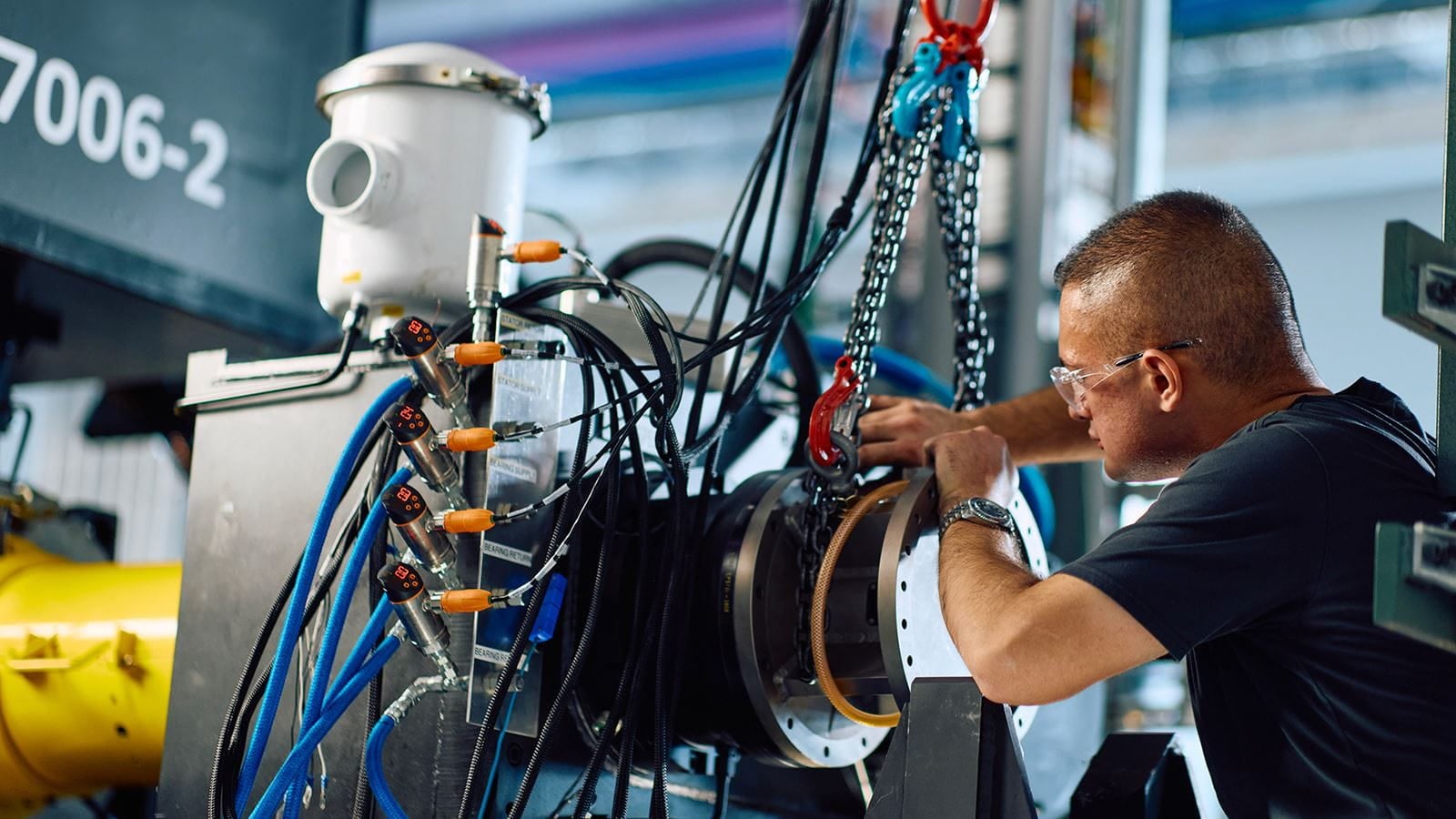
The combined powertrain includes components developed at various facilities across Europe. For instance, Collins designed and produced the megawatt-class electric motor and controllers at its Solihull site in the UK, while power distribution components, including a solid-state power controller and power distribution panel, came from its site in Nördlingen, Germany. The high-voltage electrical wiring interconnection systems developed by GKN were built at Papendrecht in the Netherlands.
“The start of powertrain subsystem testing is a key step towards demonstrating the potential of applying more electric systems to future commercial aircraft,” said Smith. “Hybrid-electric technology has the potential to transform aviation by enabling greater fuel efficiency across multiple future platforms, including next-generation single-aisle aircraft.”
